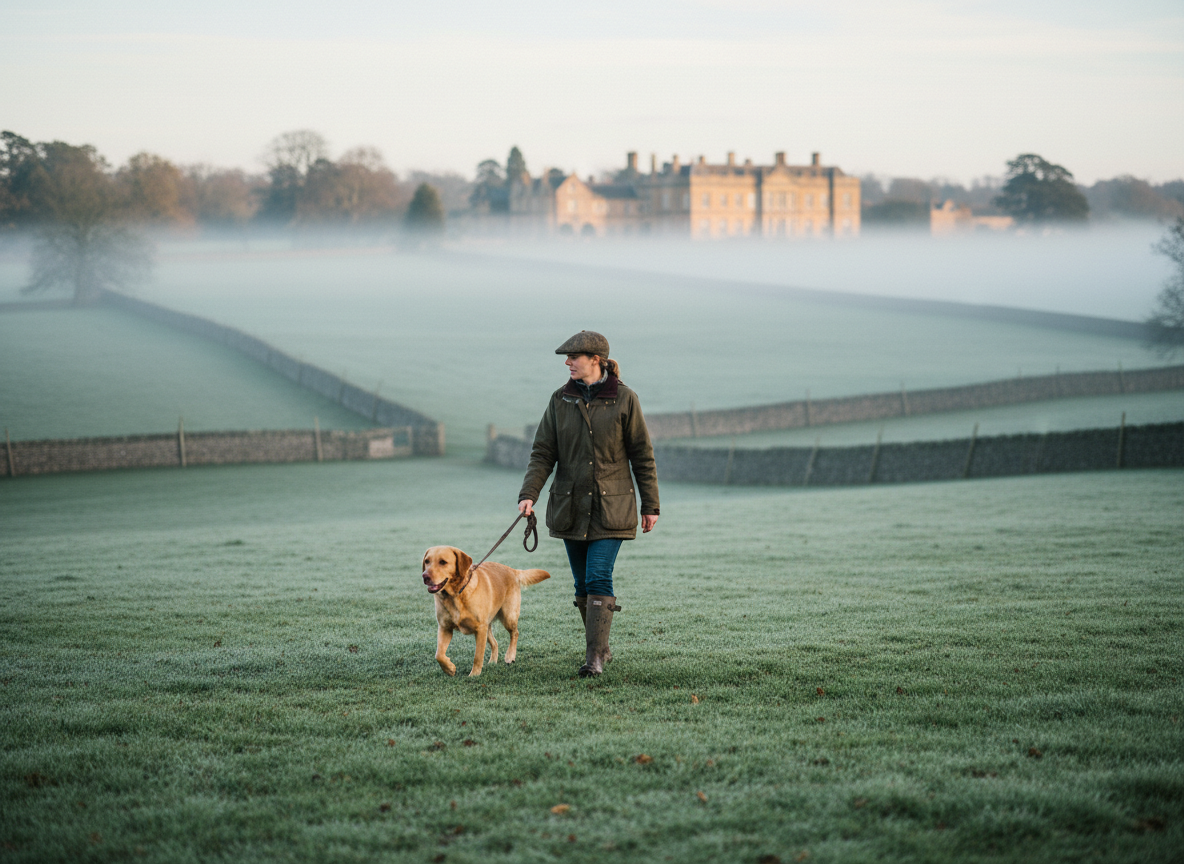
The term 'pre-trained' is used loosely. Here is an honest account of the months of structured work that turn a puppy into a composed, reliable companion ready for your home.
Among the most frequently asked questions we receive is also the most fundamental: what, precisely, does 'pre-trained' mean? It is a fair question. The term is used loosely across the industry; sometimes to describe a dog who has learned to sit, and sometimes to describe a fully finished companion. At Manor & Hound, we believe families deserve clarity; so here is an honest account of what pre-training actually involves, from a puppy's earliest weeks to the day a dog is ready for your home.
It Begins Before Training Begins
A dog's character is shaped long before any formal command is taught. The first eight weeks of life, spent with mother and littermates, lay the emotional foundations for everything that follows. Puppies raised in a calm, enriched environment, handled gently, and exposed to ordinary household sounds develop into dogs who approach the world with confidence rather than fear.
This is why our puppies are raised in homes, not kennels. They hear the clatter of kitchen life, the voices of children, the radio, and the vacuum. They learn, from the start, that the human world is their world.
The Foundation Stage
Around eight weeks, structured training begins, gently and in short sessions suited to a young mind. The foundation stage is not about obedience in the formal sense. It is about teaching the puppy how to learn: how to focus, how to offer behaviour, and how to accept guidance without anxiety.
Key foundations include name recognition, early recall, gentle lead work, and, perhaps most importantly, place training. The place bed becomes the dog's anchor: a space where they learn to settle, to be still, and to self-regulate. This single behaviour, more than any other, produces the calm indoor presence that distinguishes a well-trained companion.
Socialisation runs parallel. The puppy meets other dogs, strangers of all ages, and experiences car travel, different floor surfaces, the countryside, and the town. Each encounter is managed so that it builds confidence rather than overwhelm.
The Development Stage
As the dog matures, training becomes more demanding. Distractions are introduced deliberately: other dogs at play, food on the ground, and the comings and goings of a busy street. A recall that works in a quiet garden must eventually hold in a park full of squirrels and children. A loose-lead walk in the hallway must translate to a high street.
This stage is where the real investment lies. It is unglamorous, repetitive work; there are hundreds of sessions and thousands of reinforcements. There is no shortcut. Reliability is built, one repetition at a time, and it cannot be rushed without fracturing.
The Refinement Stage
By adolescence, a Labrador's energy and confidence peak, and this is when training is most often tested. A dog who responded perfectly at six months may, at nine, decide that the lead is optional. Consistency through this period is essential; it is the difference between a dog who emerges steady and one who develops habits that take years to undo.
In the refinement stage, we sharpen the basics into genuine reliability. We work on distance control, longer settles, and public manners, such as settling quietly in a café, travelling calmly in a vehicle, and greeting strangers without jumping. The dog learns to generalise their training: to behave the same way at home, in town, and away.
Ready for Home
A dog we consider ready for a family home is a dog who can be trusted. They settle when asked. They walk without pulling. They come when called. They greet people politely. They are house-trained, crate-trained, and accustomed to the rhythms of domestic life. They are not robots; they are living, feeling companions, but their behaviour is reliable enough that a family can simply enjoy them.
Crucially, they are also adaptable. A dog trained only in one environment struggles when that environment changes. Our dogs are raised across multiple settings, with multiple handlers, so that the transition to your home is a small adjustment rather than a shock.
The Handover
Pre-training does not end at our gate. The handover is the final, vital stage, because a dog's behaviour must transfer from our guidance to yours. We spend time in your home, demonstrating commands, explaining the dog's routine, and ensuring the whole family is confident. The dog already knows what to do; our role is to help you ask clearly and consistently.
We also remain available afterwards. The first weeks in a new home are a period of adjustment, and questions invariably arise. A pre-trained dog is not a finished product delivered in a box; they are a living companion whose training continues, gently, throughout their life.
An Honest Expectation
If there is one thing we hope families take from this, it is that 'pre-trained' represents many hundreds of hours of deliberate, patient work. It is not a label applied lightly. When you welcome a Manor & Hound companion, you are receiving the fruit of months of consistent effort; and, in return, years of uncomplicated joy.
Begin the Conversation
If this resonated, we would be delighted to discuss our available dogs, training levels, and how a Manor & Hound companion might fit into your family's life. Each placement begins with a private consultation.